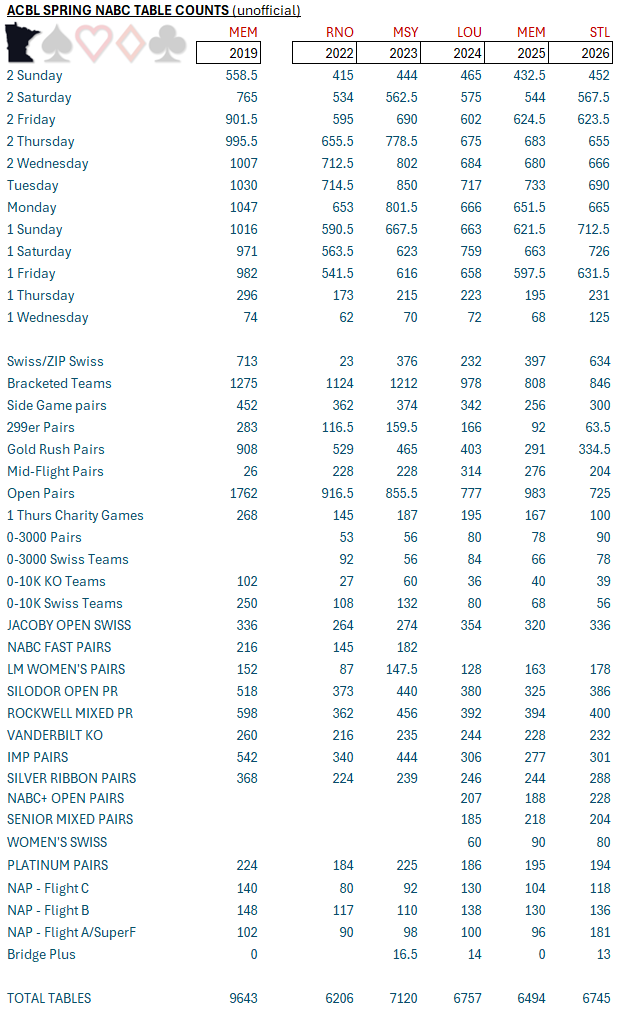
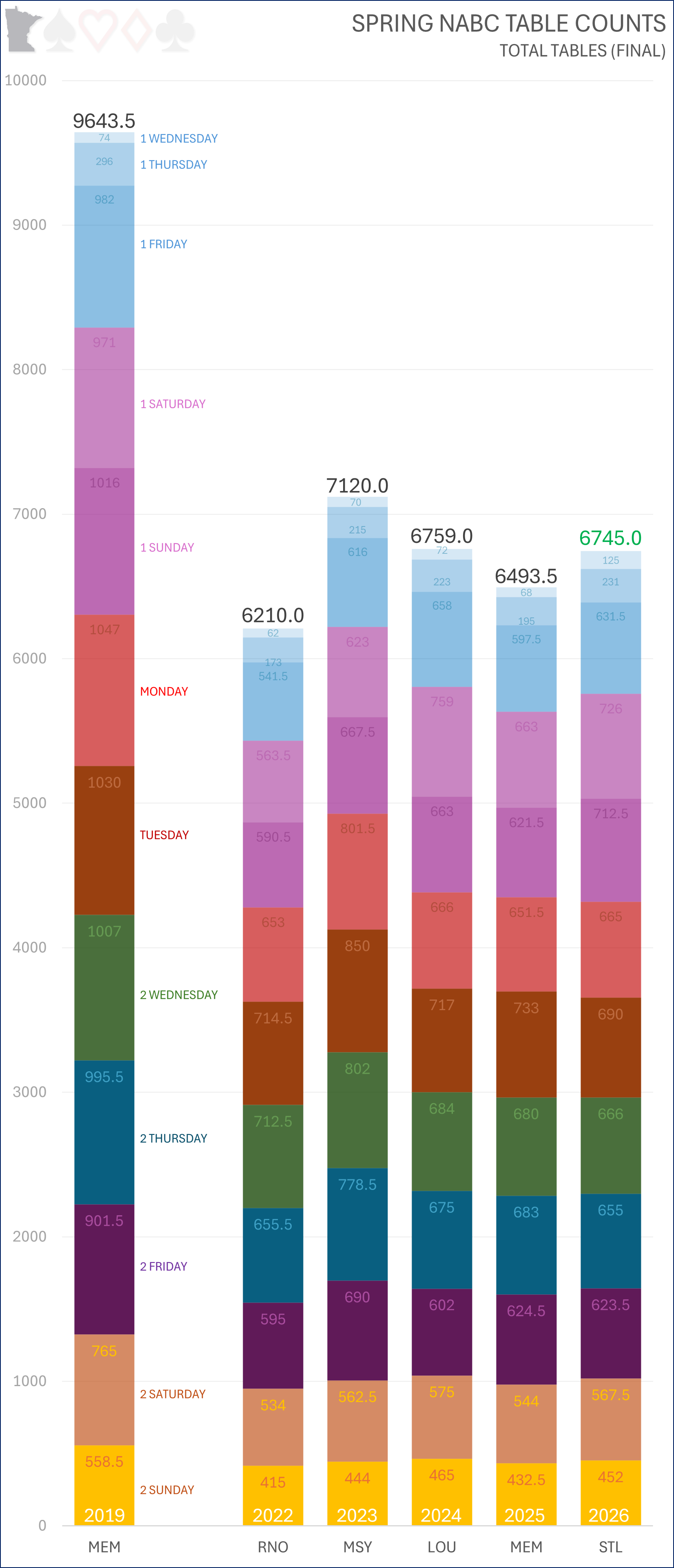
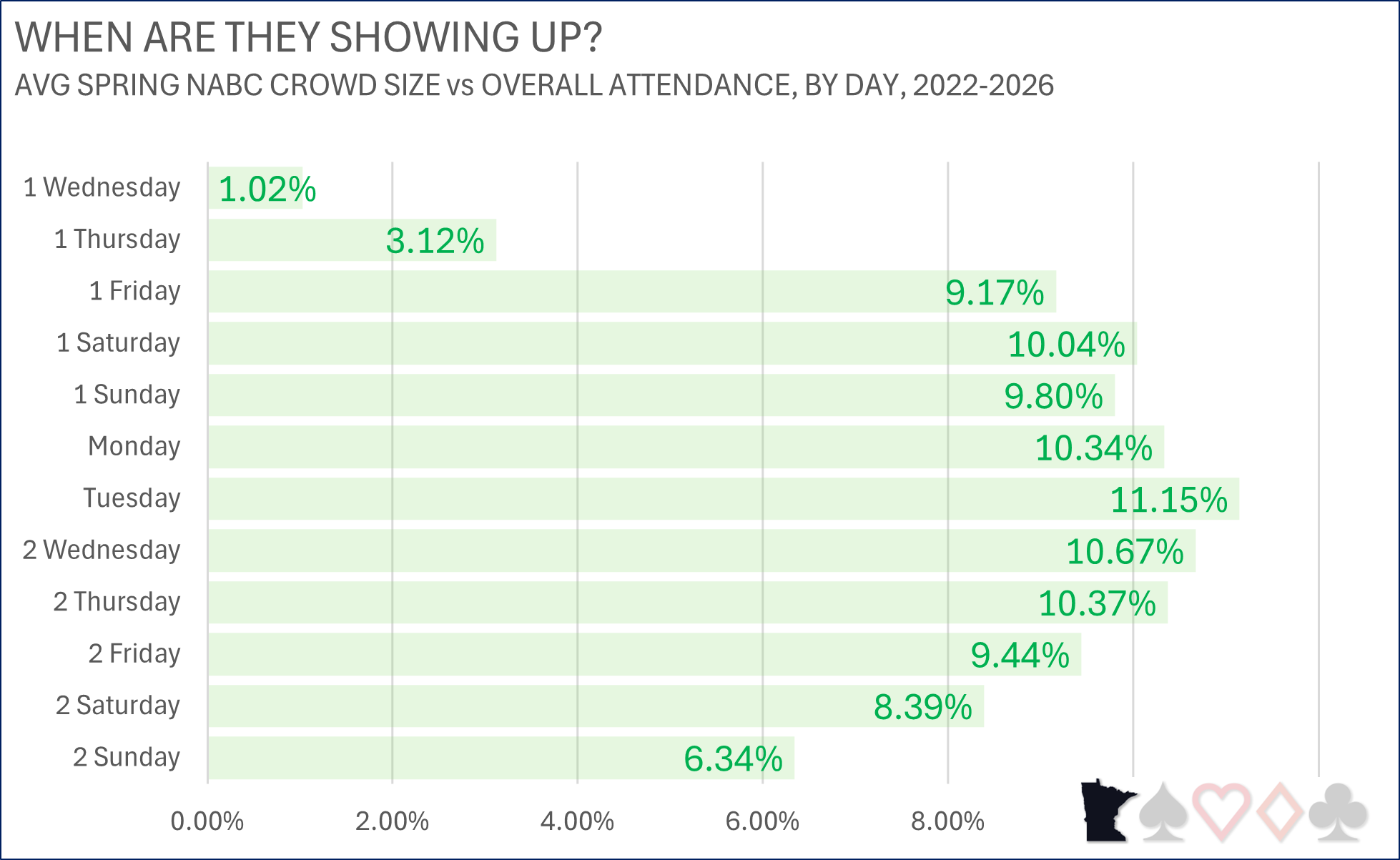
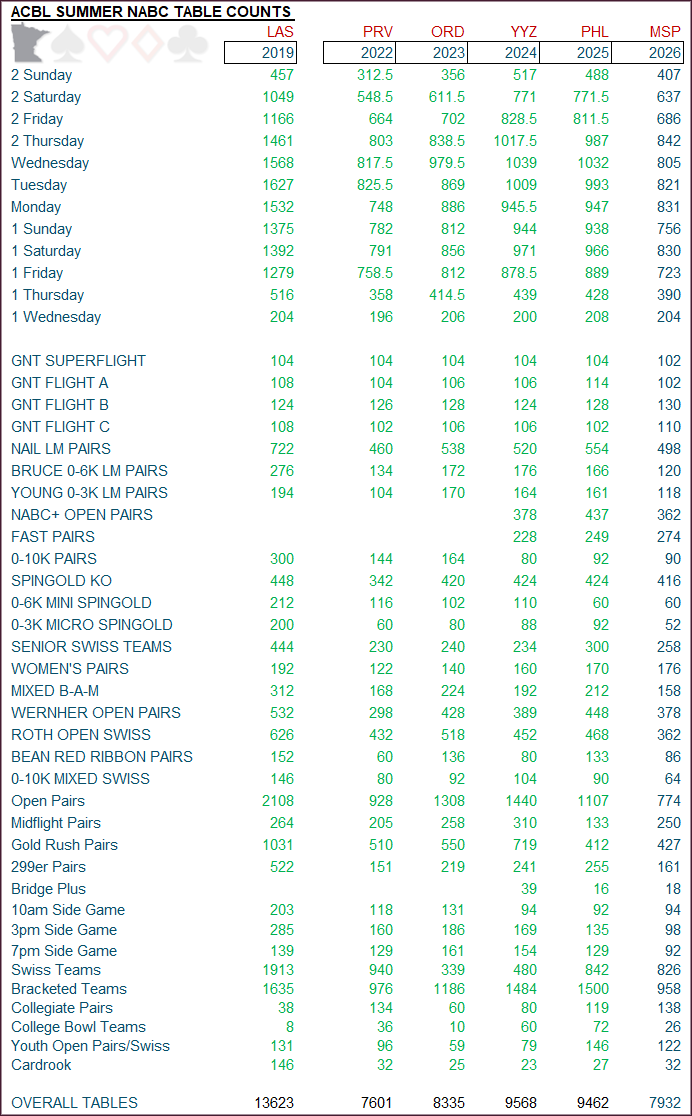
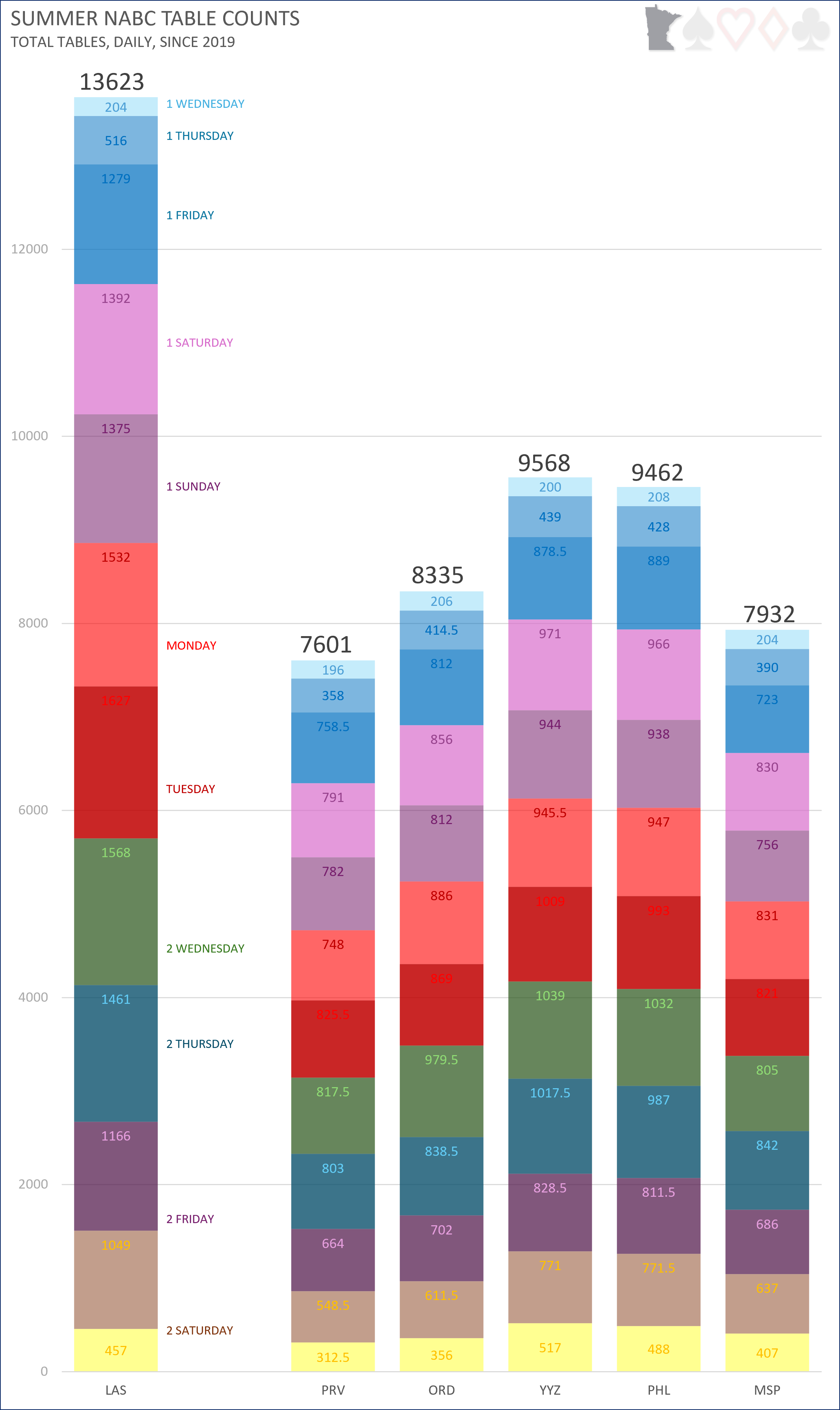
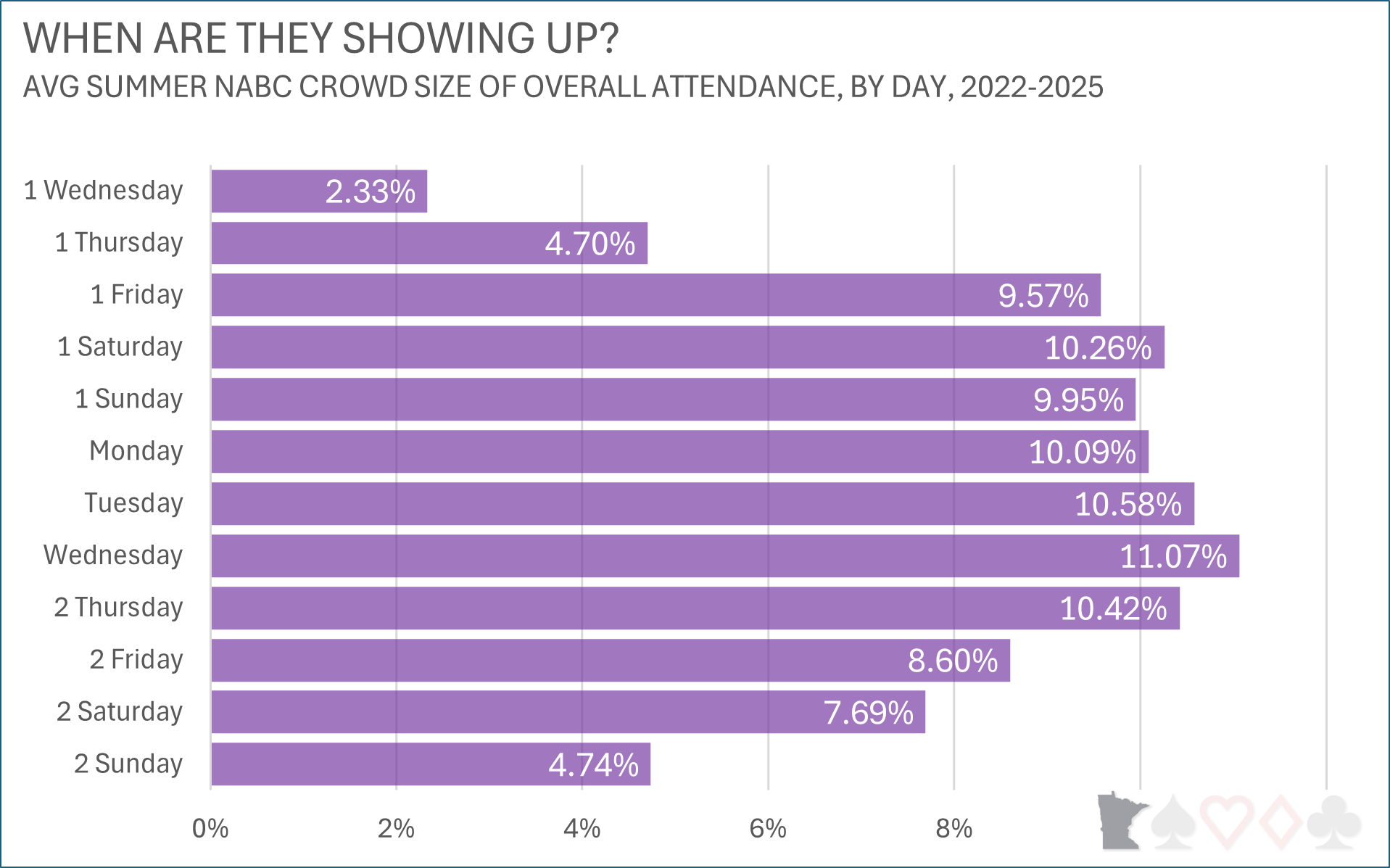
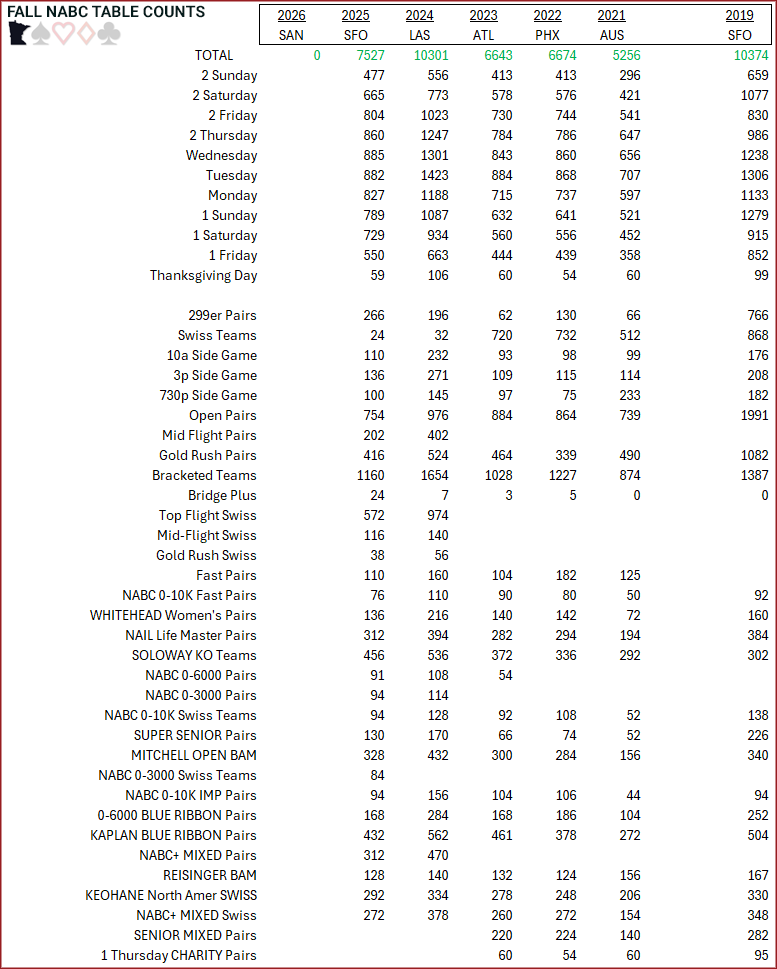
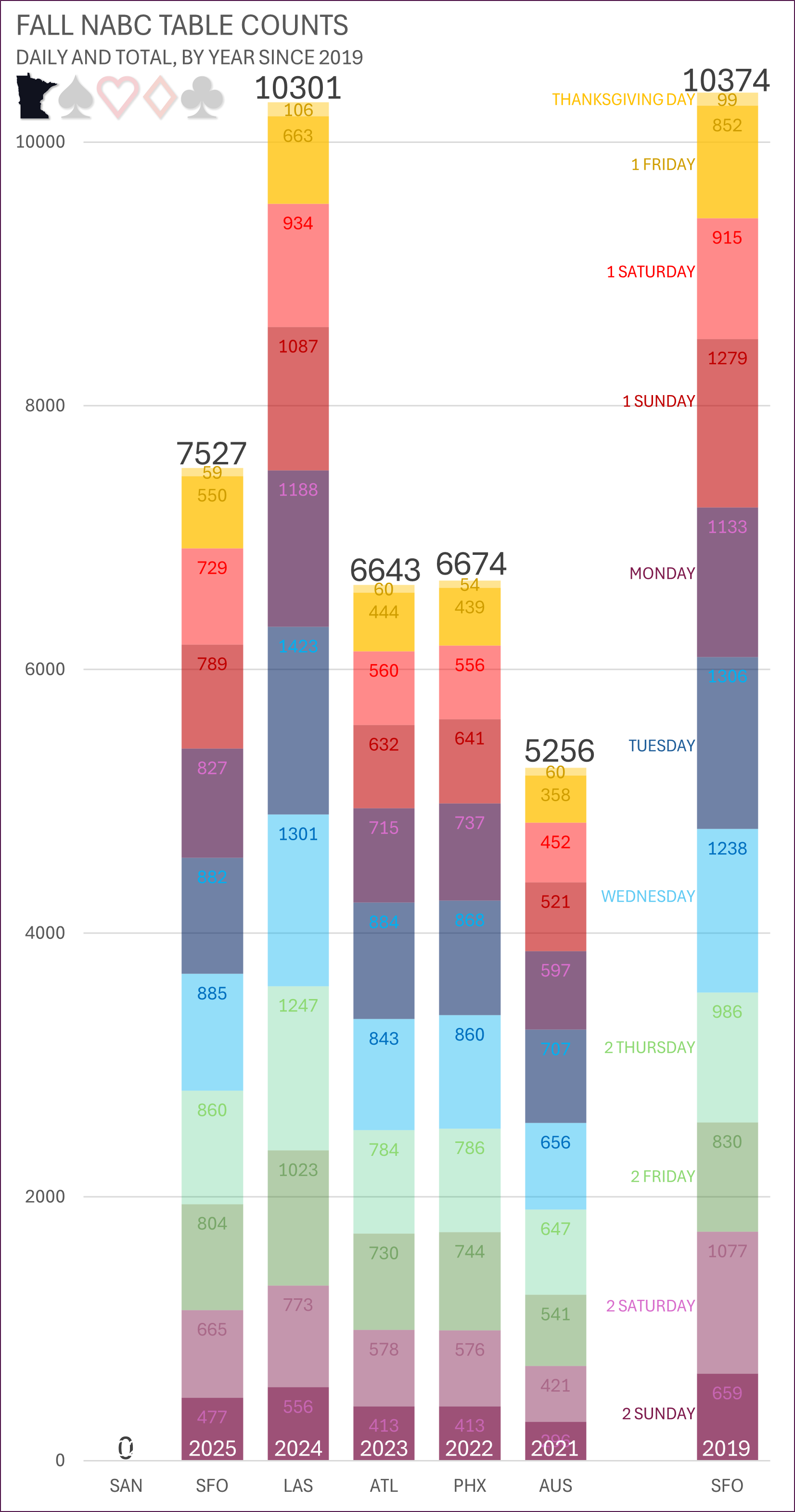
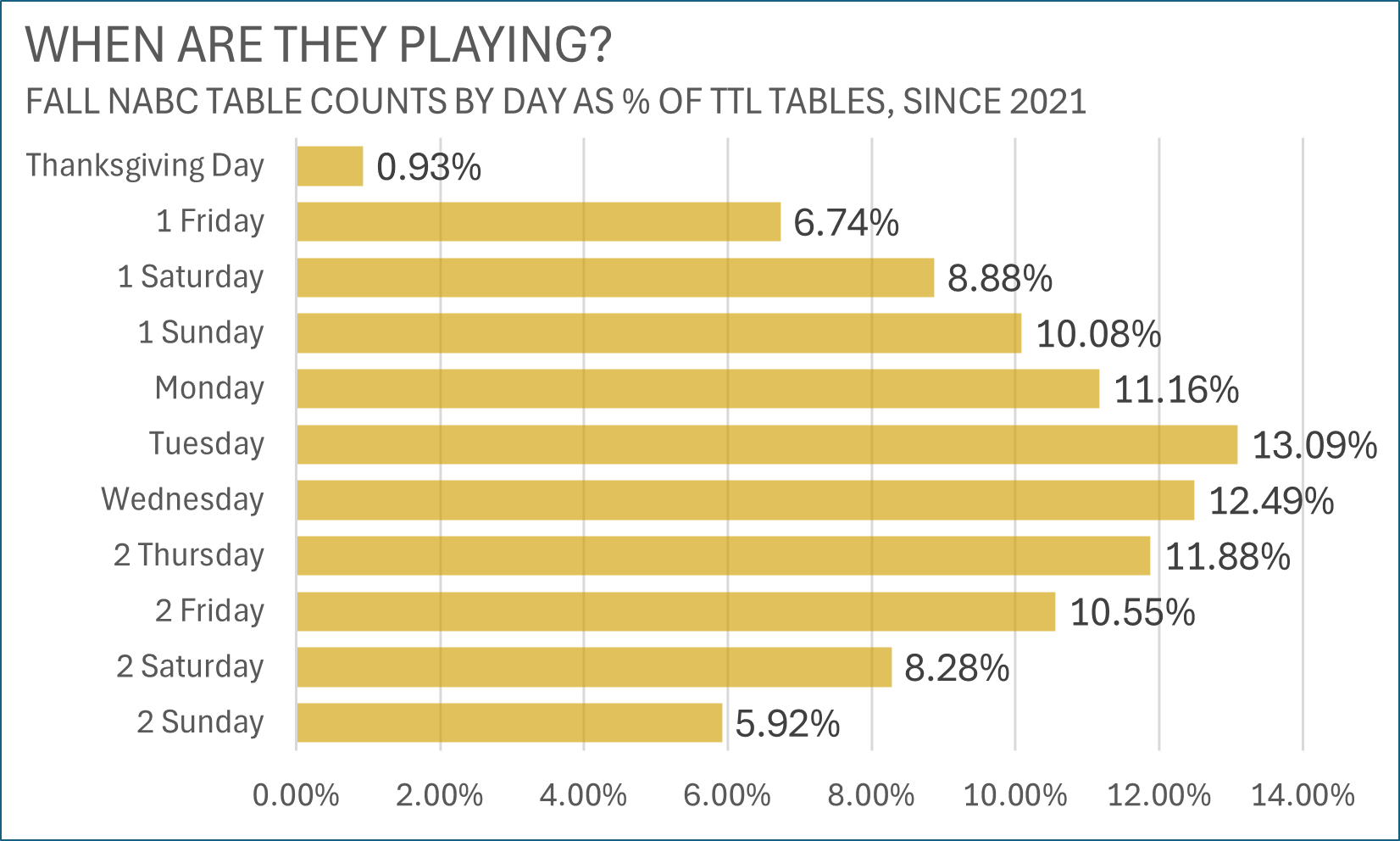
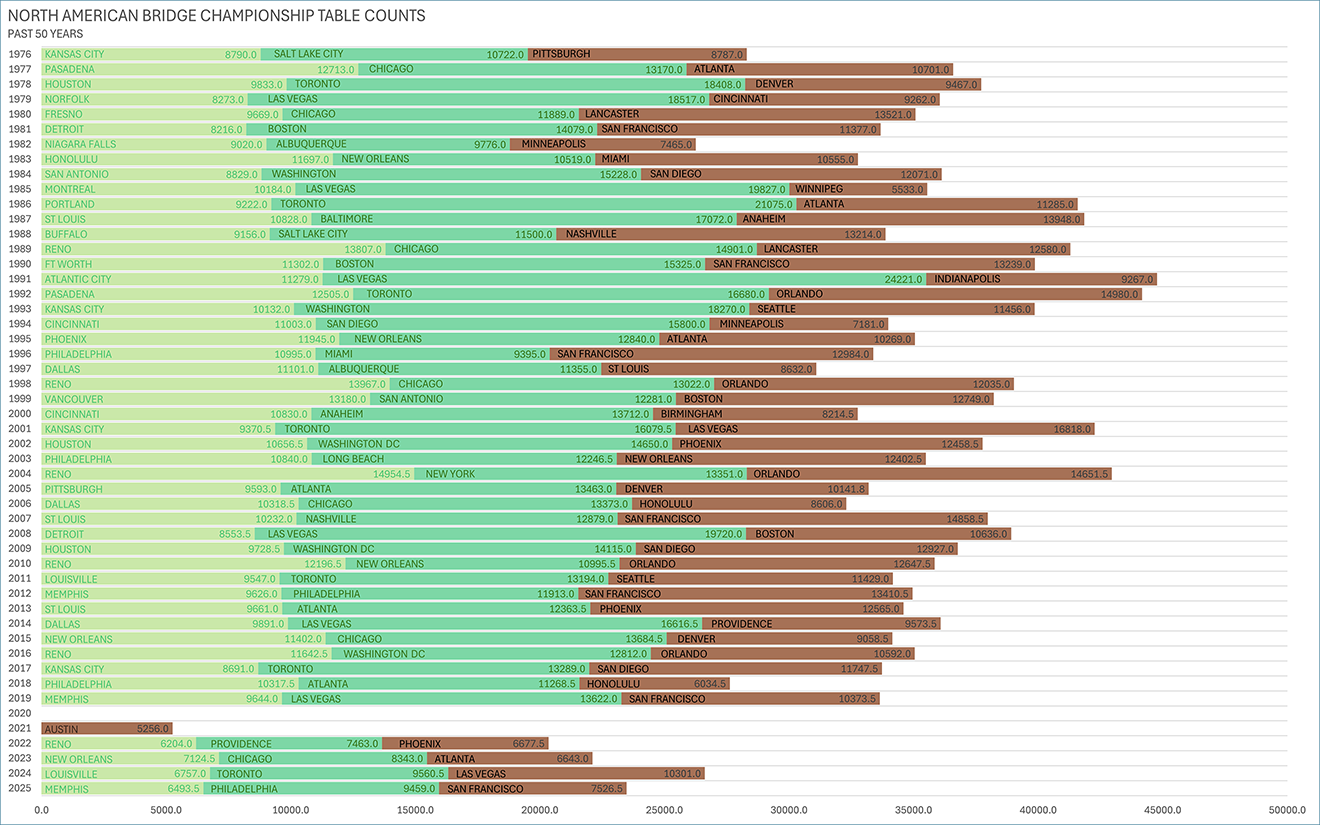
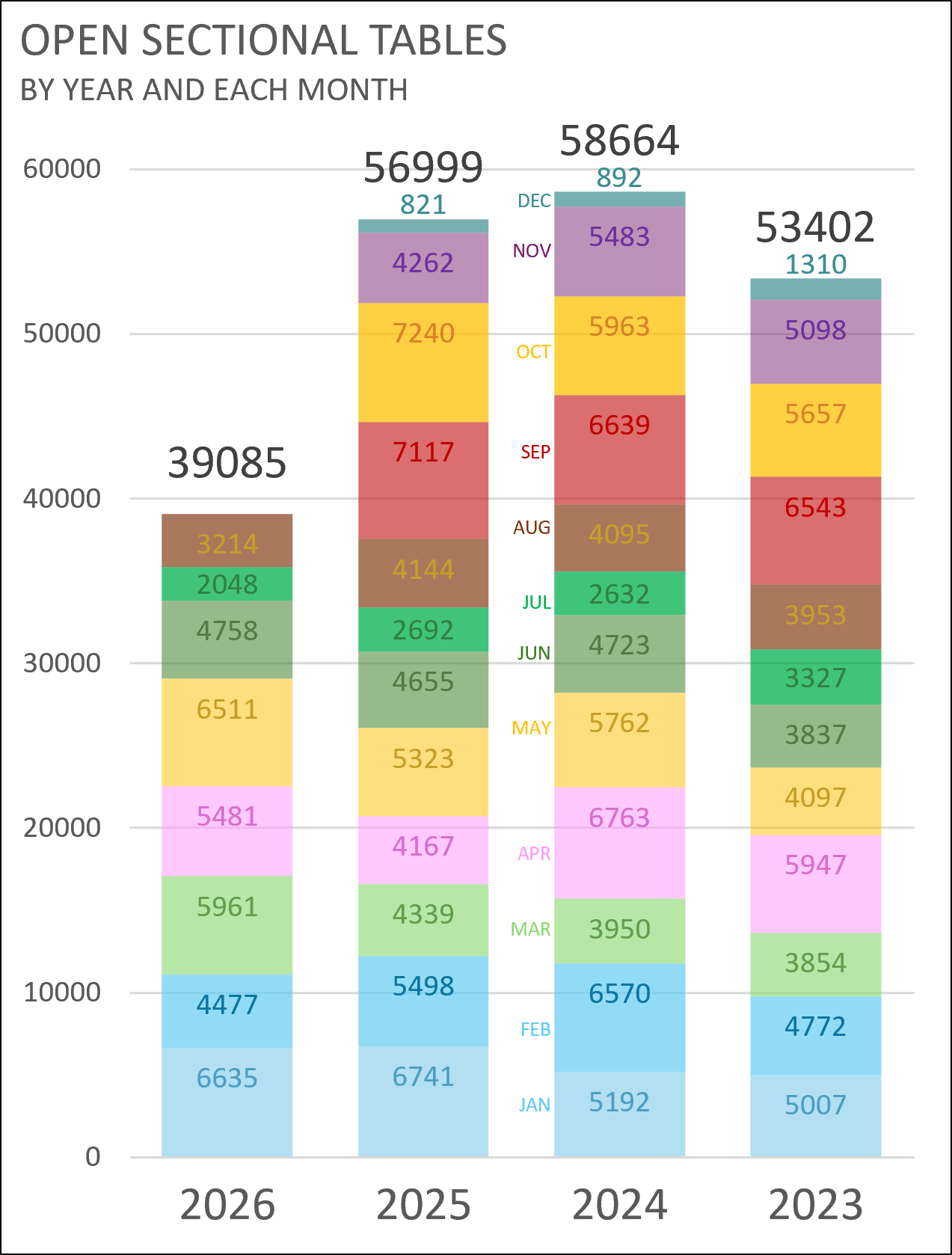
For regional and sectional tournaments, as well as club games, year-over-year table count comparisons are from 2026 to 2025, and are for face-to-face tables only (there are no online tables counted, except where noted); data presented here stretches back to the most recent pre-COVID events in most cases; and while ACBL's Brass "[may not] be interested in numbers", we are here for that party. (Feel free to use any of this information should you find it helpful, but please provide a link to this page or attribute a credit to "MinnesotaBridge-dot-com".) |

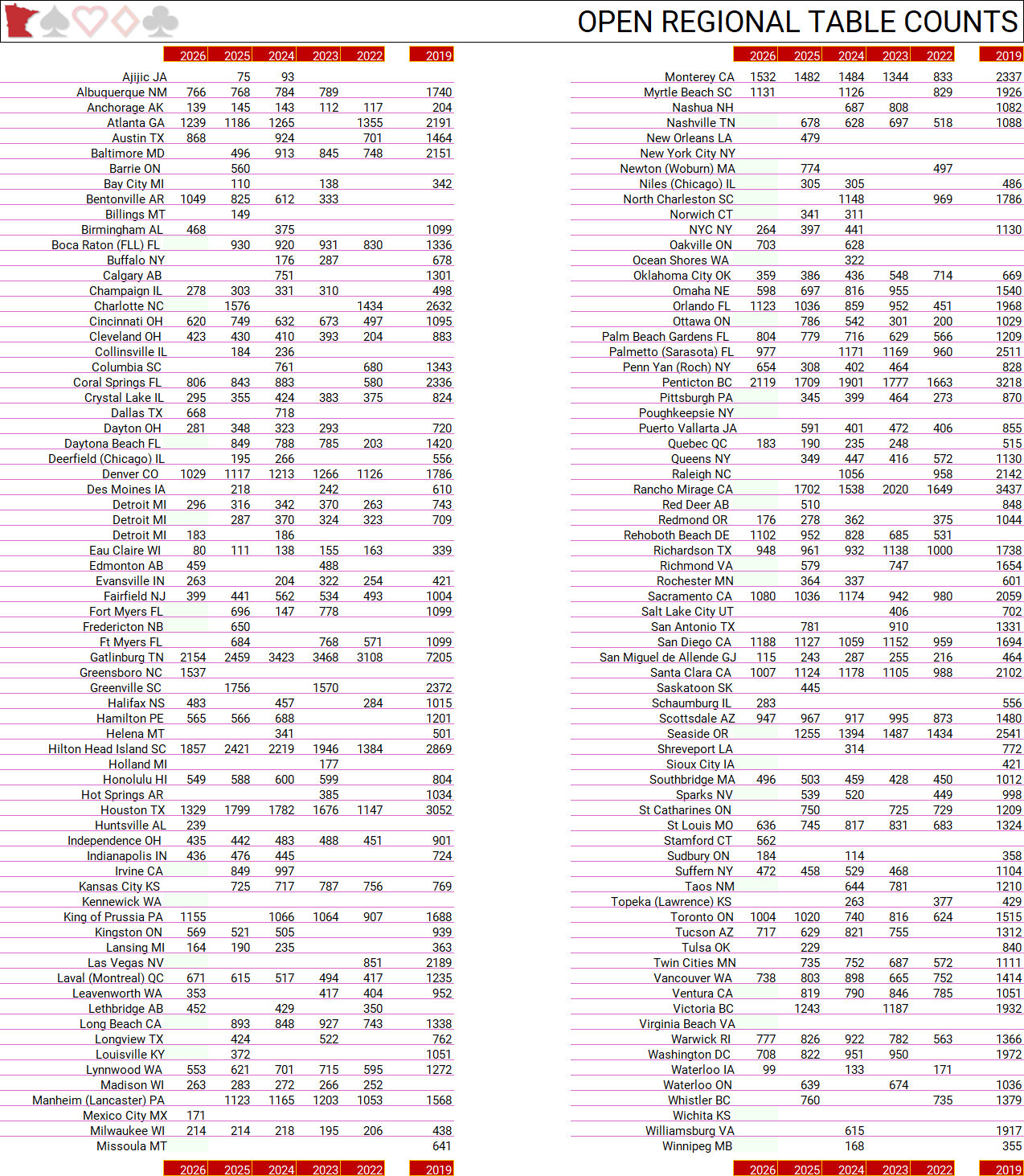
Daily and total tables, + by each event
|
Daily and total tables, + by each event
|
Daily and total tables, + by each event
|



  |
|
 |
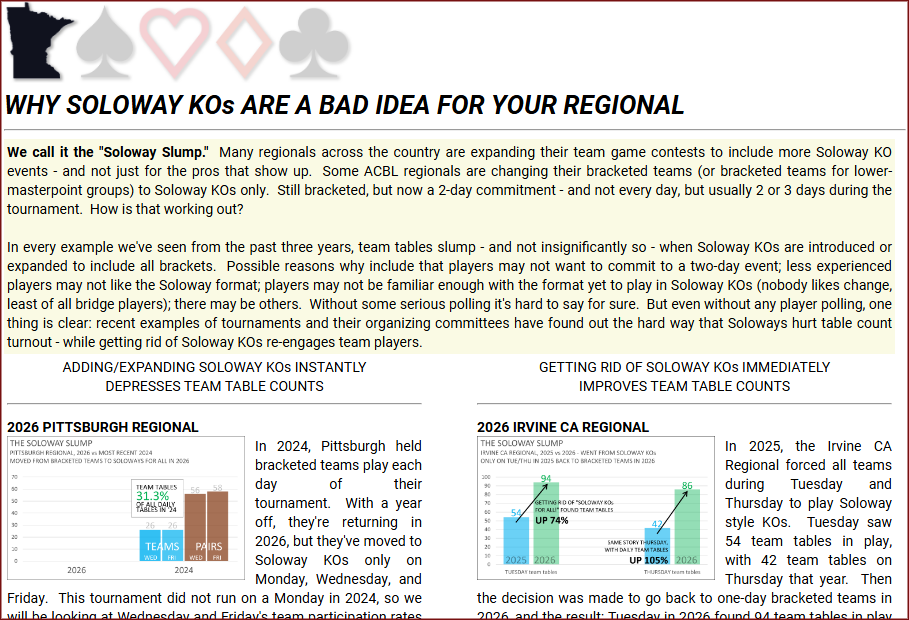 |
Click on the image to your left, or click here to get taken to this subject that has seen such overwhelming and one-sided evidence that the whole topic deserved its own webpage. |
 |

 |
 |
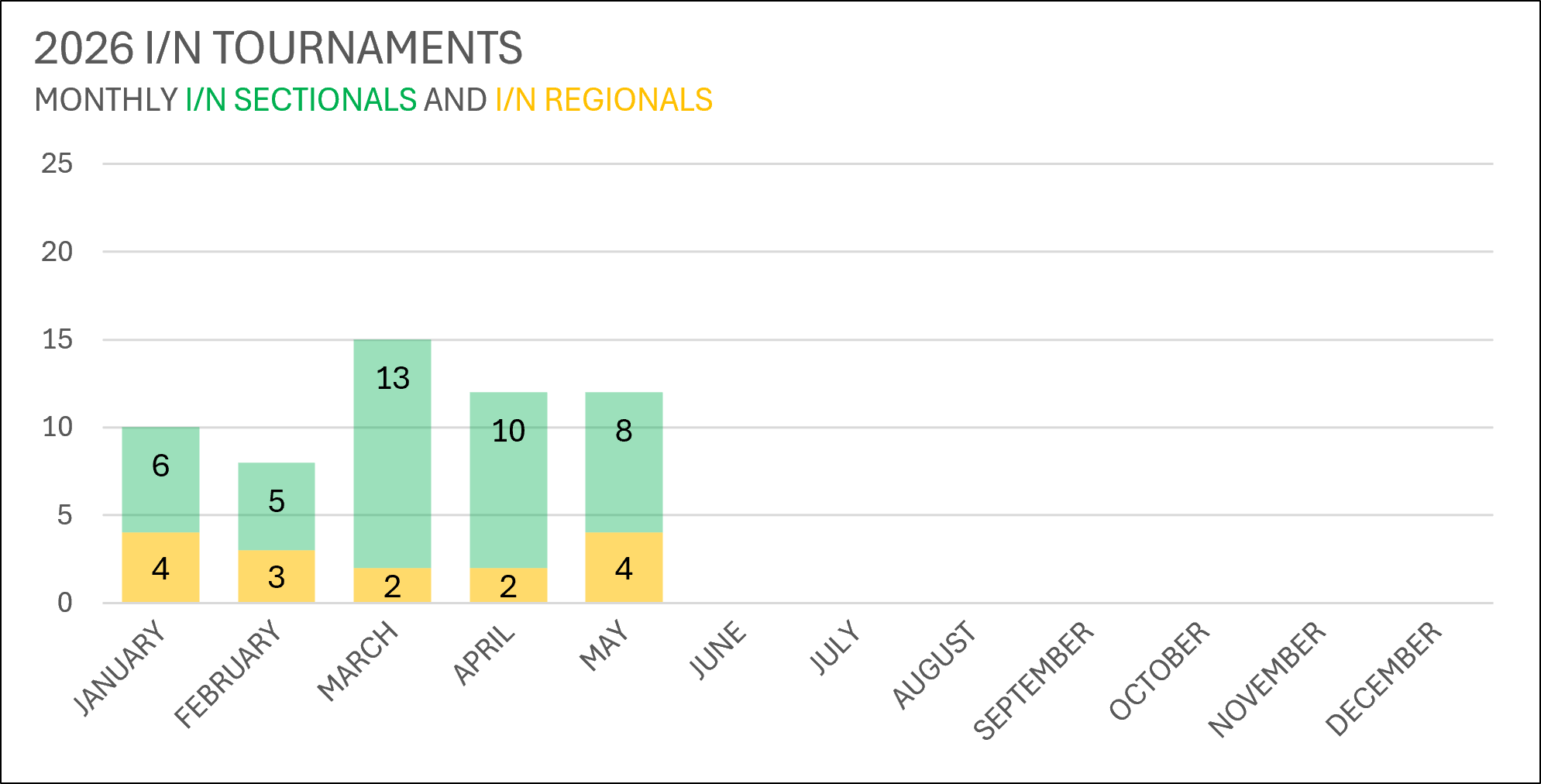
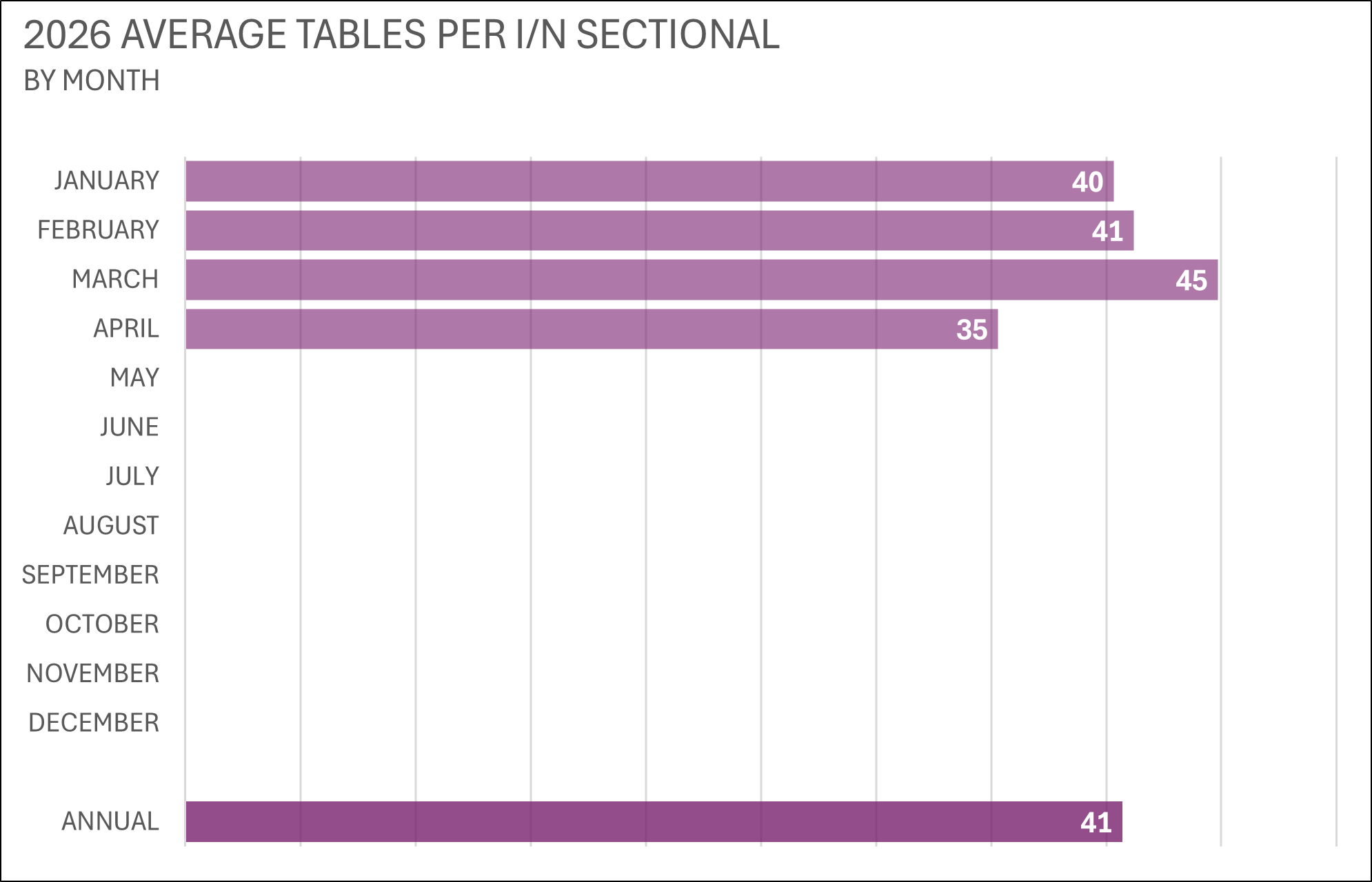
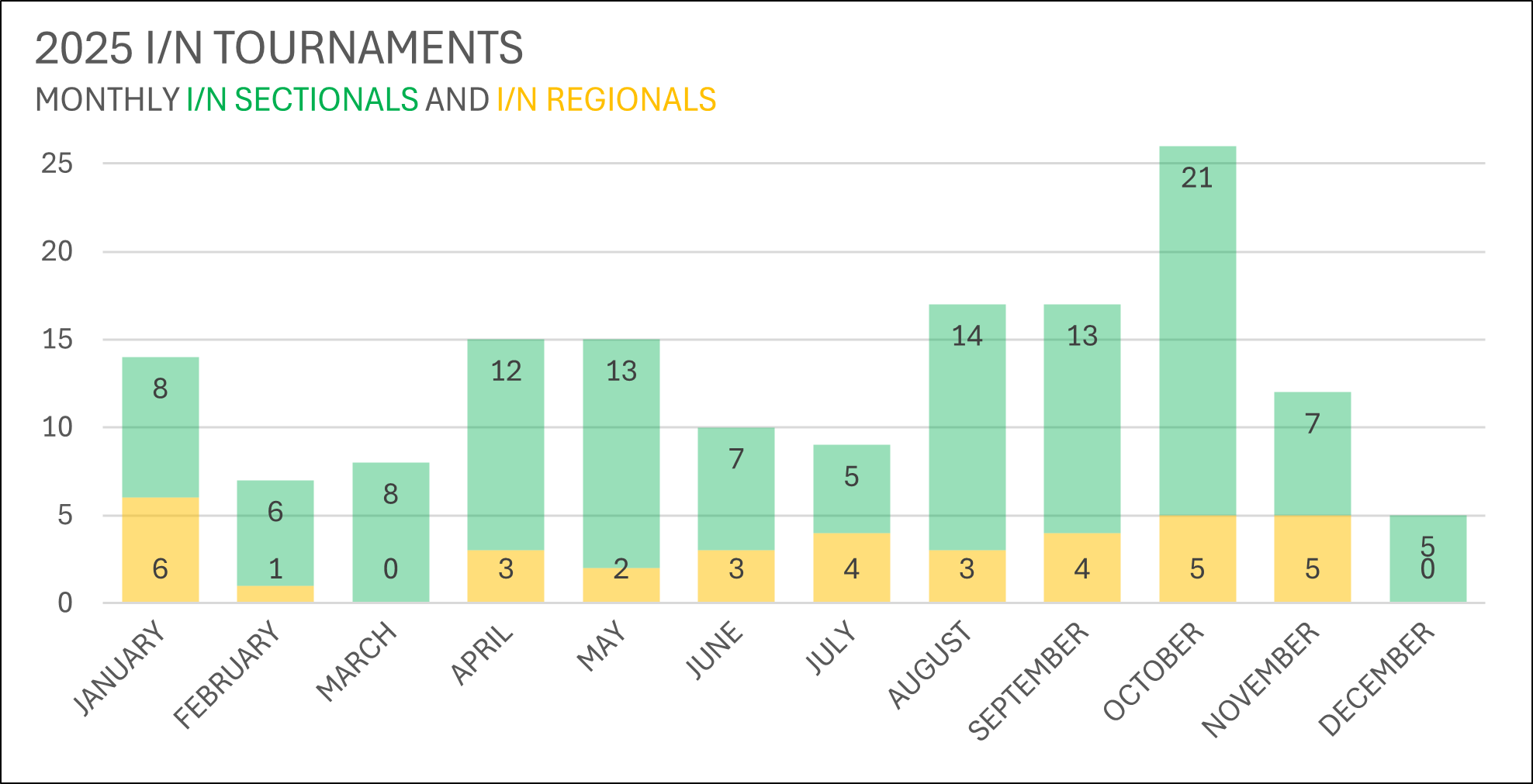
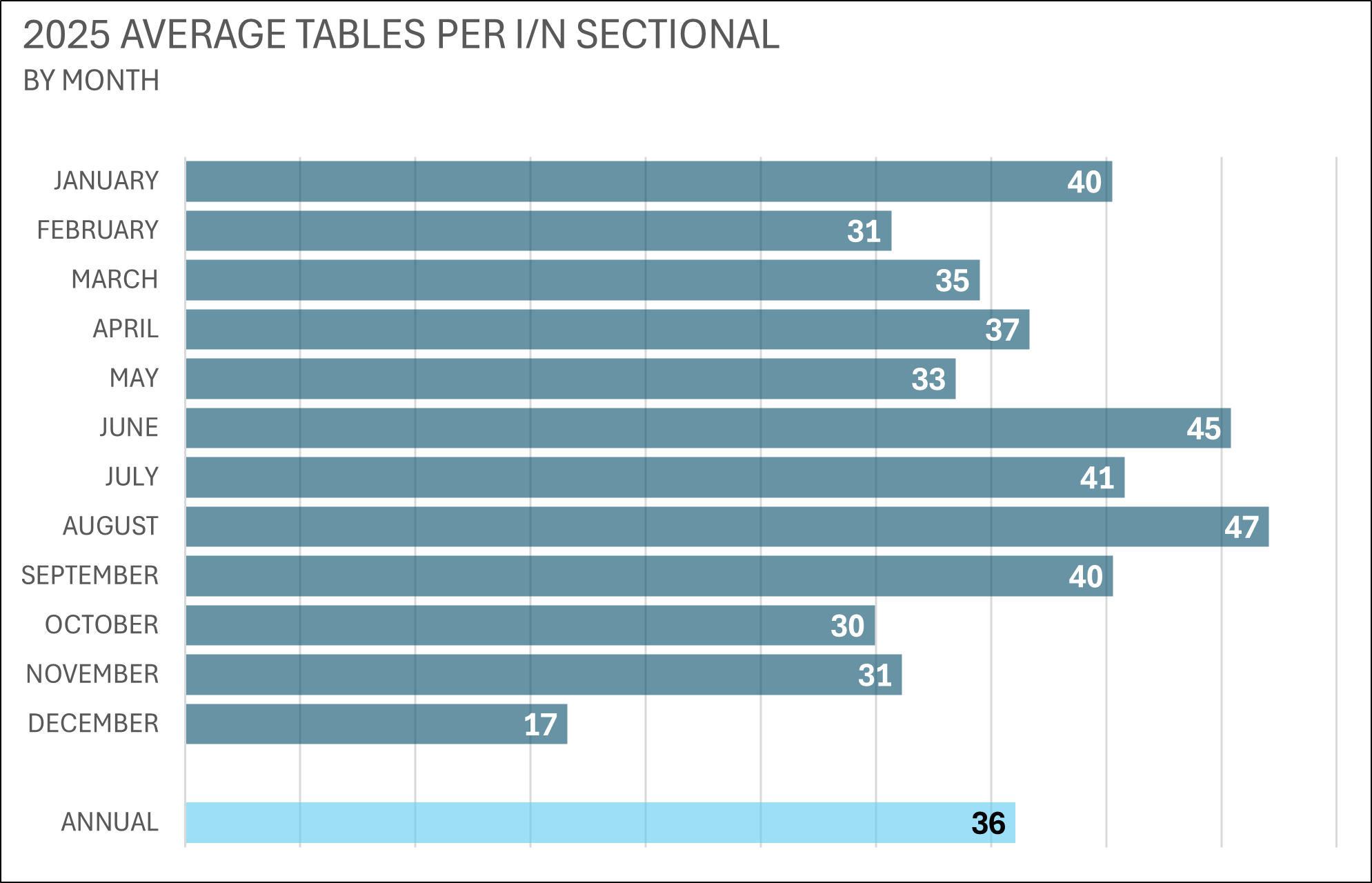
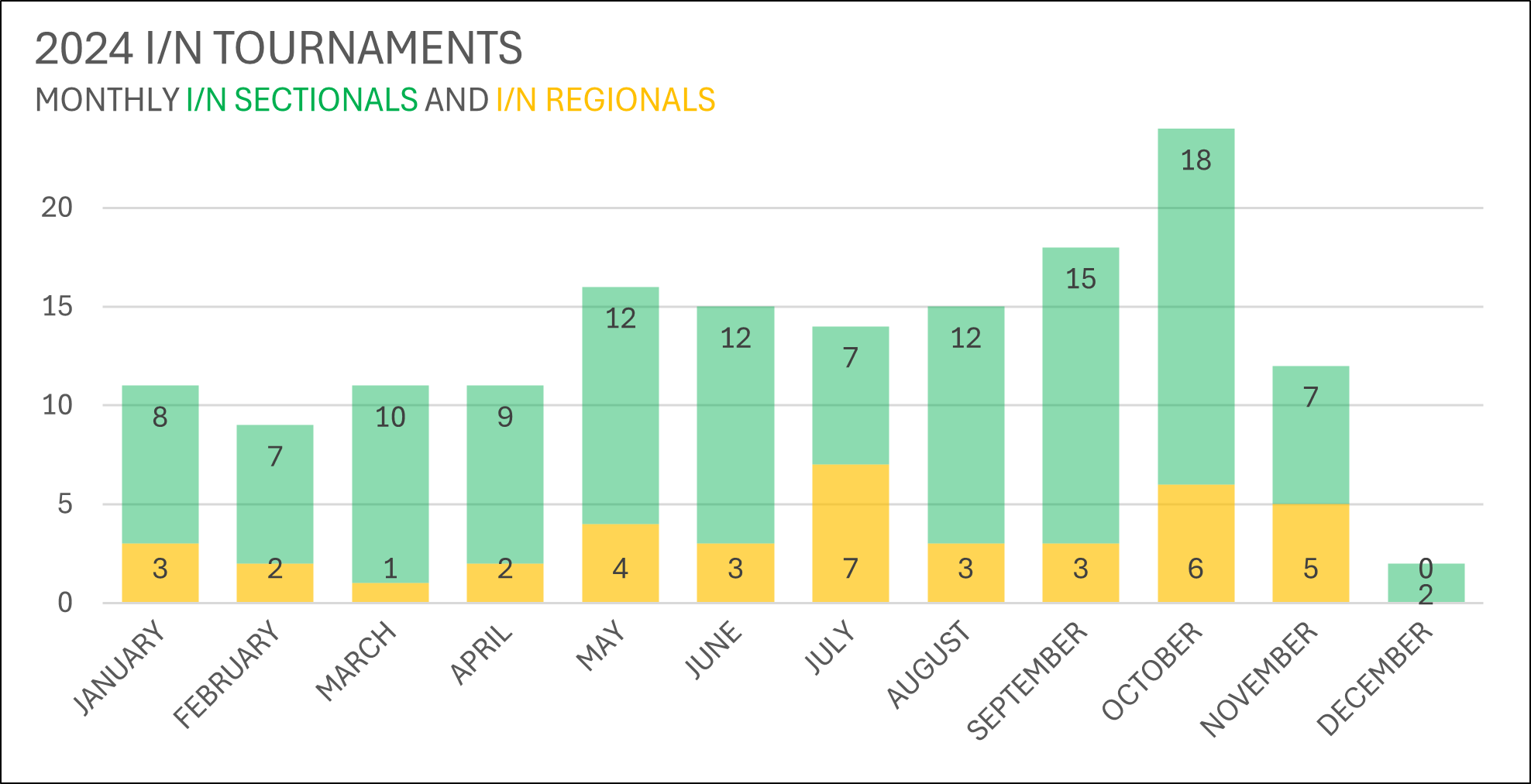
   Open sectionals can be led by ACBL staff or by a "local" director, generally to save the sponsor some money, and some are run concurrently with limited masterpoint regionals. Here's a chart of the type of open sectional run each month in 2025. |

     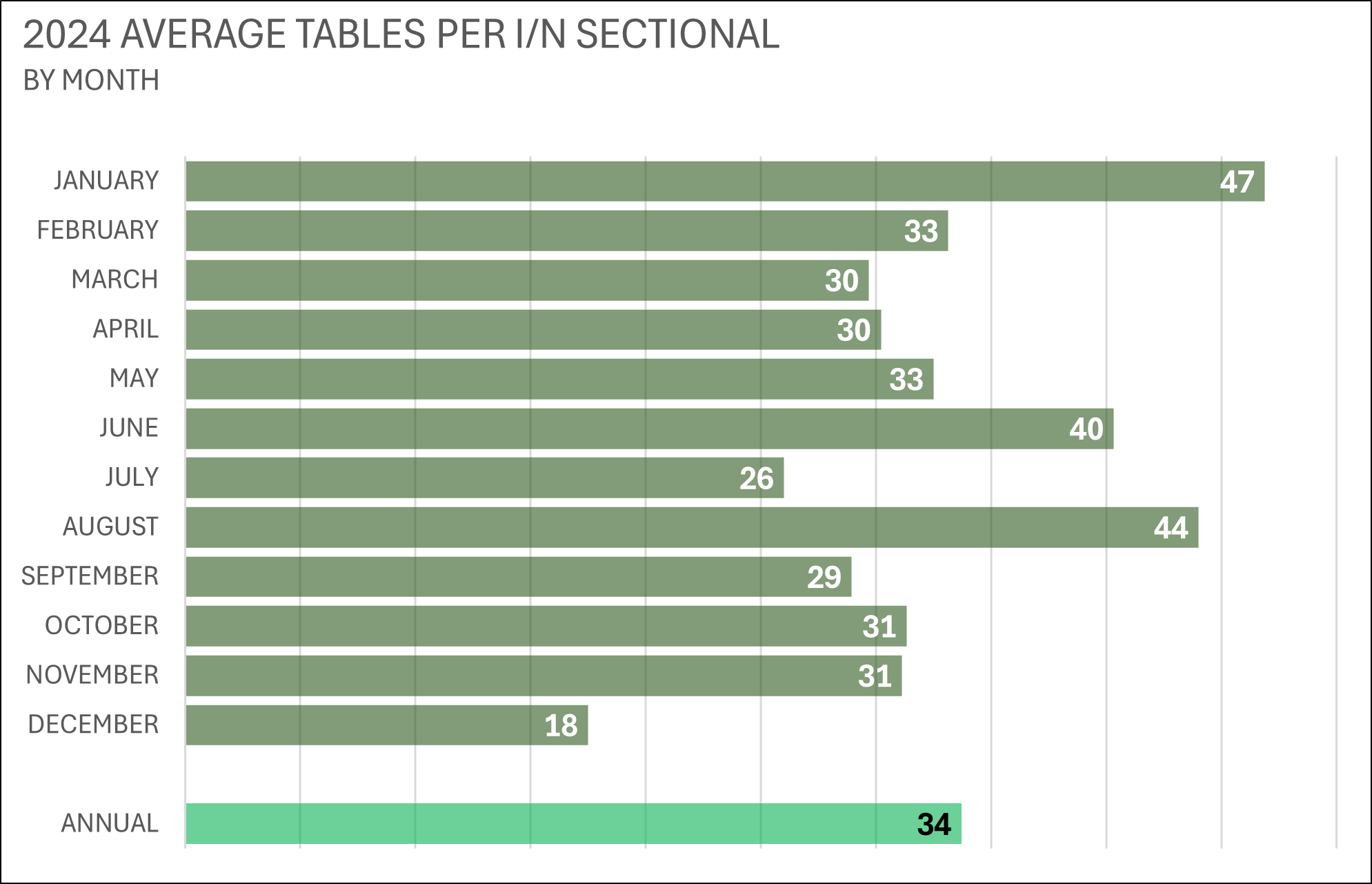  |

 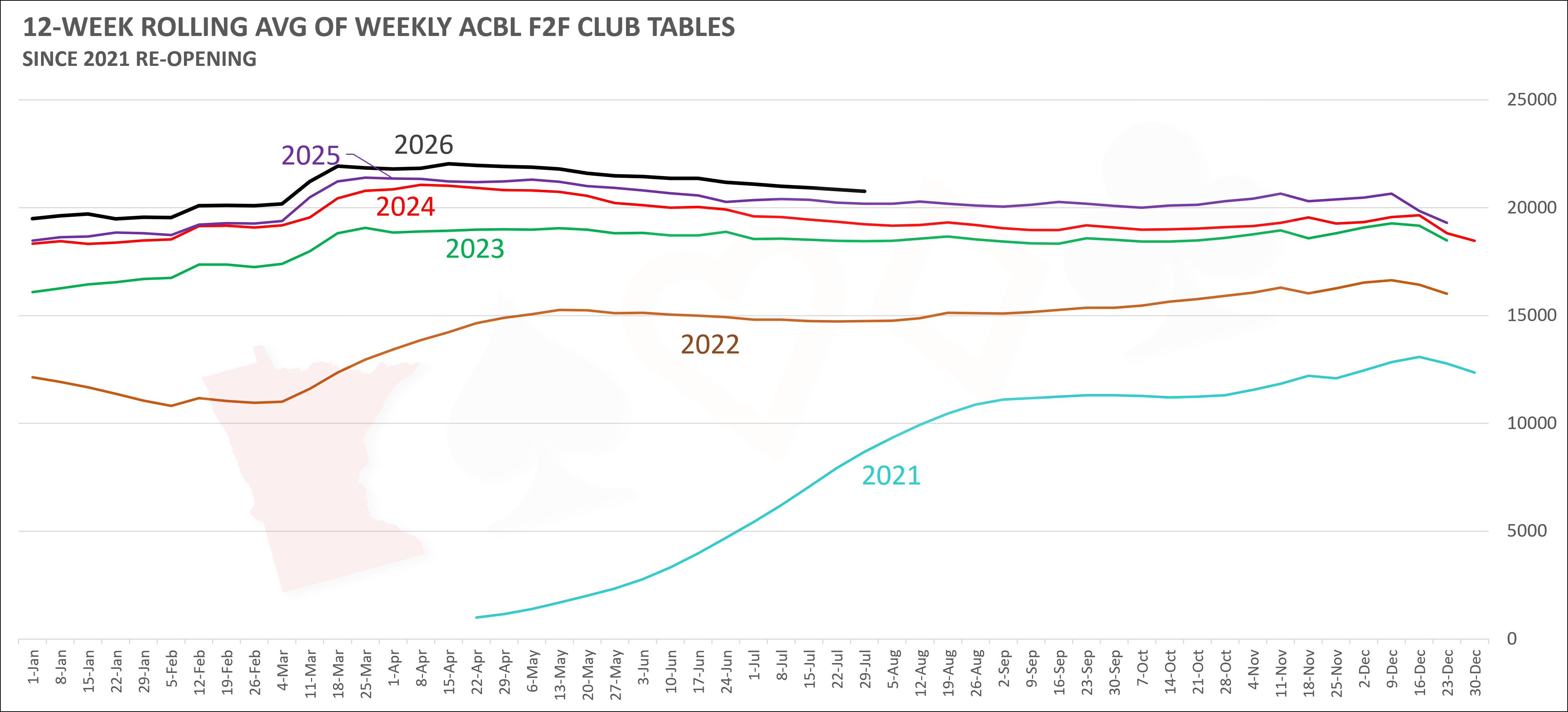 | ||
 | ||
 | ||
 | ||
 |

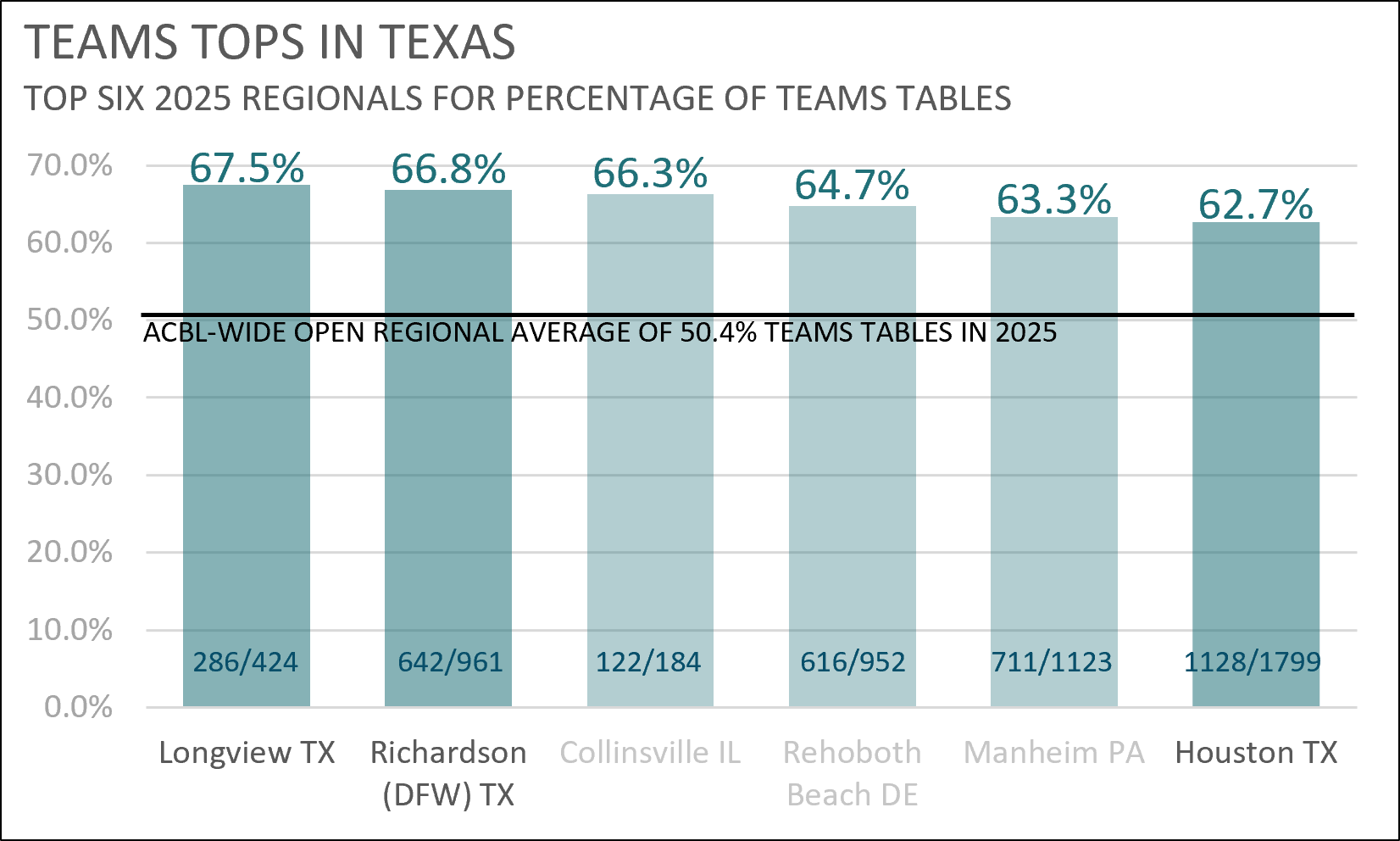 | While the overall percentage of team tables across the ACBL's 98 open regionals in 2025 was 50.4%, Longview TX (67.5%) and DFW (Richardson) TX (66.8%) held the top two spots with more than 2/3rds of their tables as team tables. Houston TX (62.7%) was the other Texas regional in the top six. The only other open regional held in Texas in 2025 was held in San Antonio TX, and while they did not make the "top six" list, the teams at that tournament were 54.5% of their total tables. That's still well above the ACBL's average of 50.4% for the year. |
 Stronger events will award more Larger events will award more Events will be masterpointed independently* Majority of awards increase or stay the same Stronger events will award more Larger events will award more Events will be masterpointed independently* Majority of awards increase or stay the sameThe new formula is below. (This is how they're going to figure out 1st place overall in an event, and then the additional awards get figured from that.) If you'd like examples of how this would impact masterpoint awards, all those details can be found by clicking here. All of these new formulas and masterpoint award rules will take effect on January 1, 2027, so you'll see these in action at tournaments starting in 2027. Masterpoint awards at tournaments will not be going down in any cases - and in the majority of them, they'll be increased quite a bit under this new math. Masterpoint inflation is real, and it is spectacular.  |
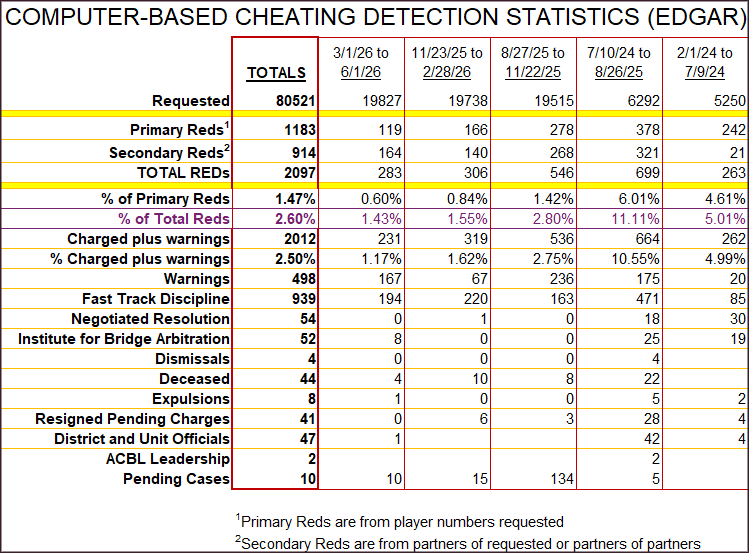  | The overall rate of cheating players across the ACBL's online community came out to 2.60% during this run; details are on the chart to your left. While EDGAR has gone through everyone that played online during that 2020-2024 period, the program is not being put out to pasture. The ACBL plans to use EDGAR for the following: Start running "new" online players that started playing after February 1, 2024 Revisit previously suspended and warned players who are now off suspension Revisit "yellow" categorized players, who have been heavily flagged for suspicious behavior Continue to run ACBL members who are proposed for high-level committees, such as the Advisory Council, Board of Directors, and Hall of Fame |
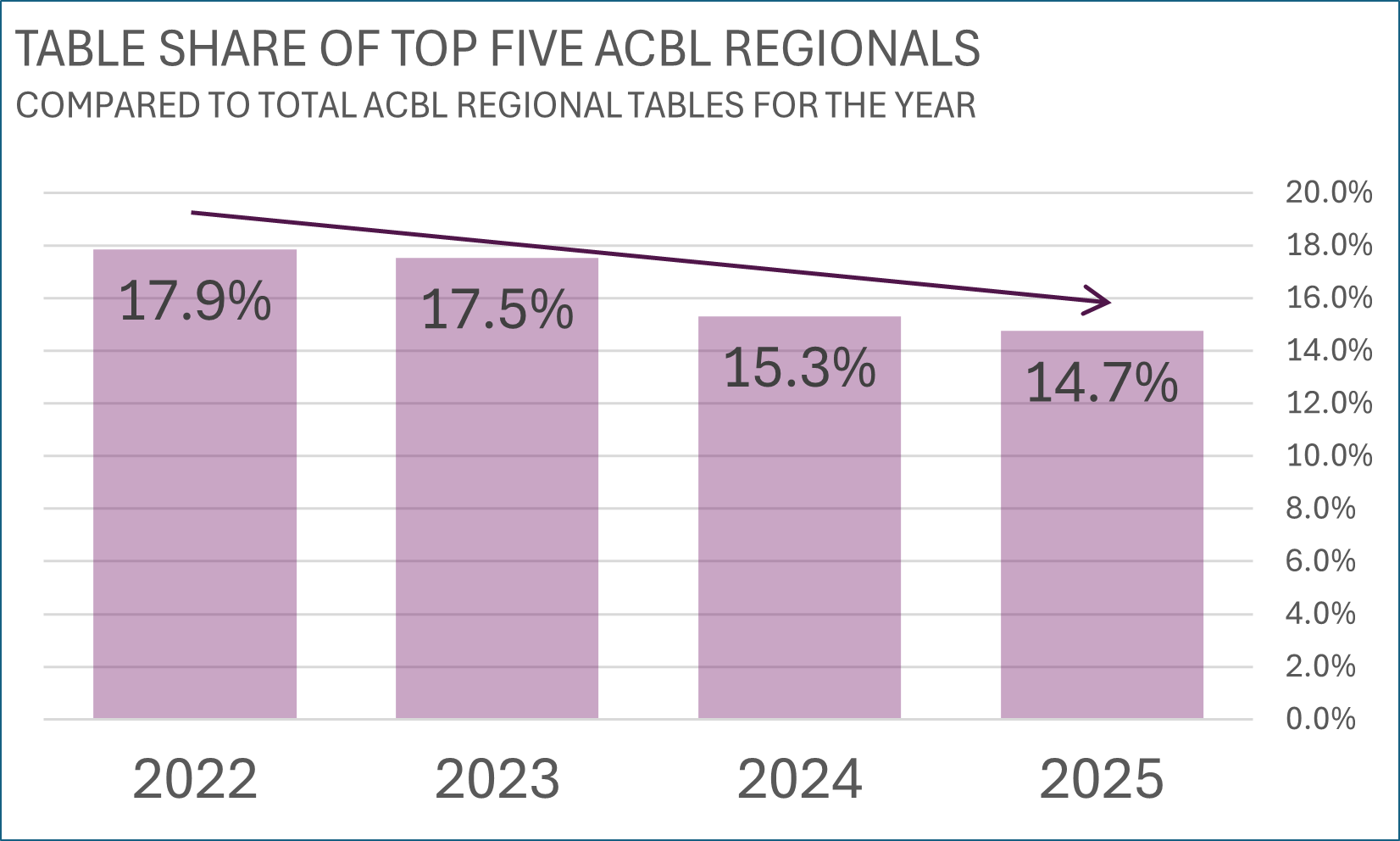 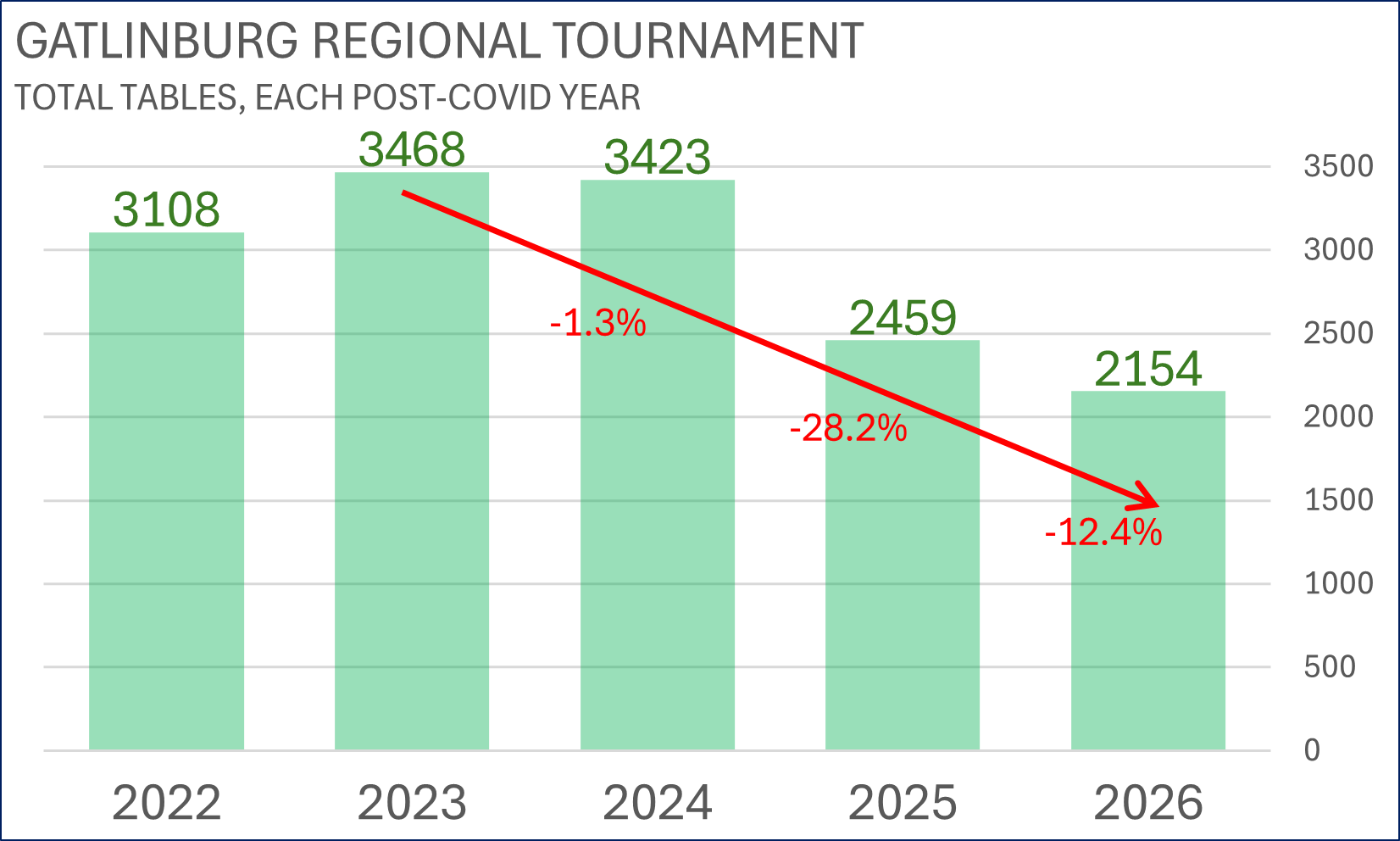 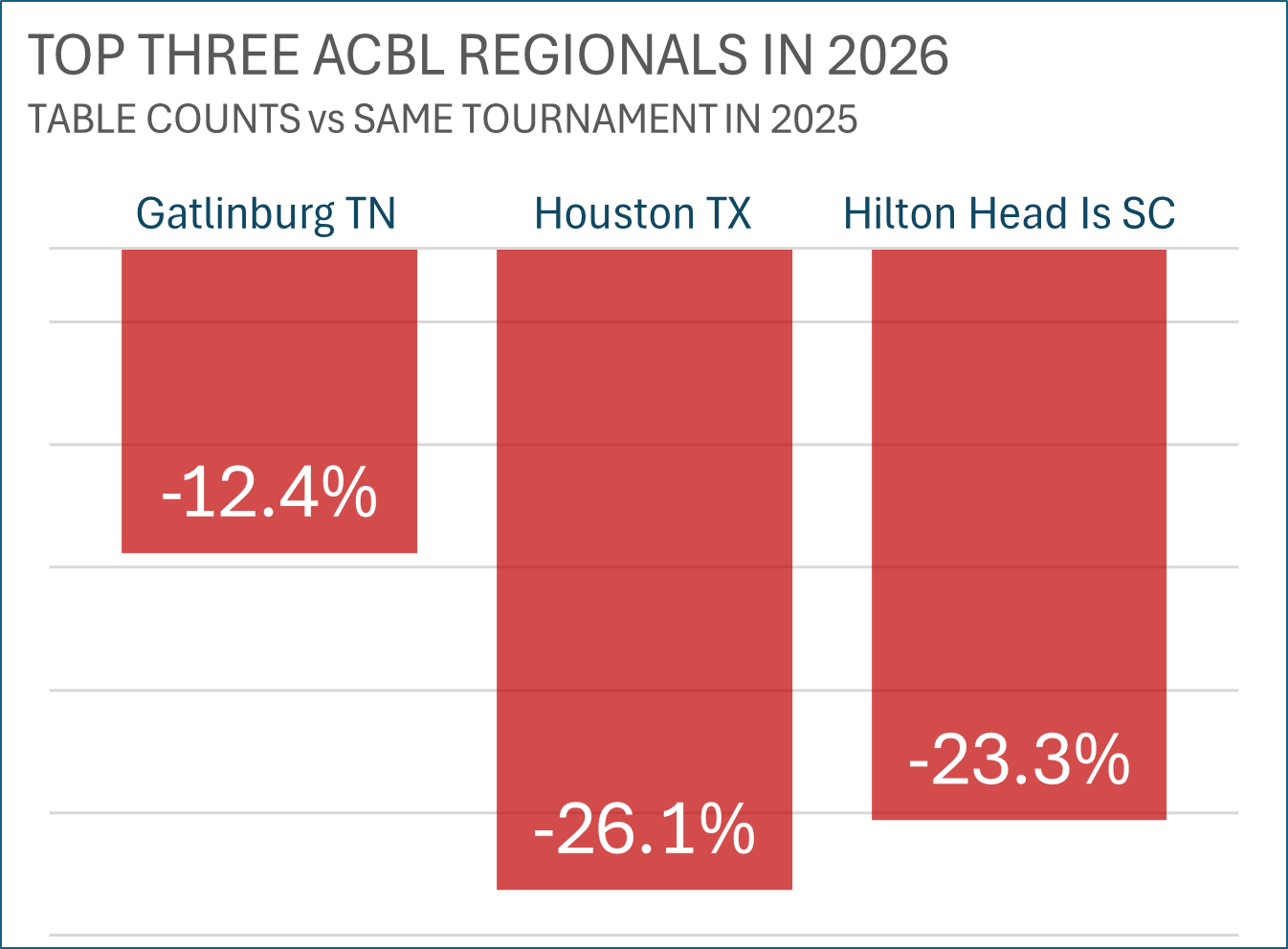
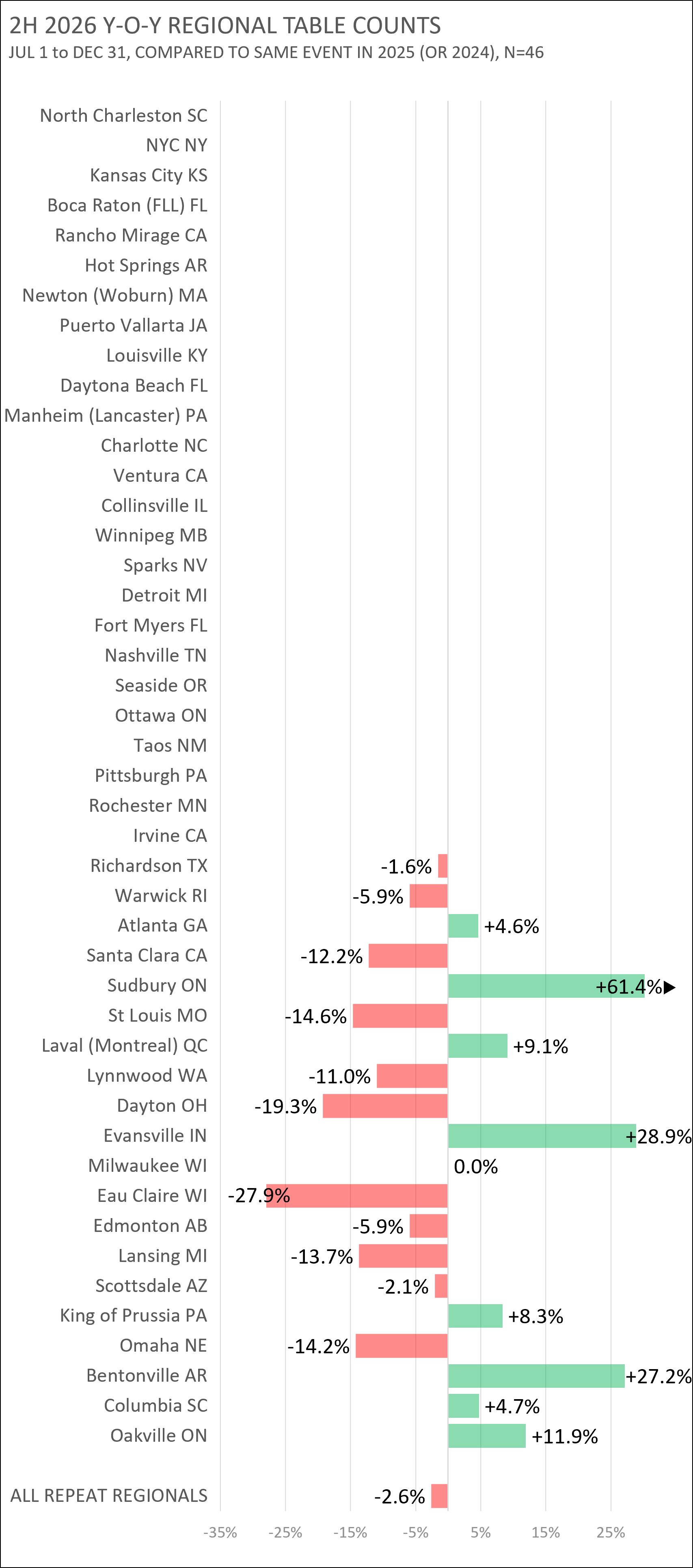
| As 2026 has gotten going, this trend doesn't appear to have changed. The first three of the "big five" have been held in 2026, and their table counts are off from 2025 - and by quite a bit. "America's Favorite Regional" as they have called it for years now, and rightfully so being the #1 tournament in attendance over the years, has really taken a plunge in attendance. In just two years, the Gatlinburg TN Regional has seen a drop in table count of -37.1%. That's more tables than most ACBL regionals have in attendance in any given year. The Gatlinburg drop of -12.1% this year compared to 2025 is considerably larger than the average drop in same-location annual regionals, which sits at -7.0% as of this blog post. In fact, the top three ACBL tournaments from 2025 are all way off on tables this year - Houston TX was down by -26.1%, and Hilton Head Island SC was down by -23.3%. With some regional table counts are up (and many down), this shows that even the largest and most popular regionals are not immune to the general downtrend in participation. One other note: the Houston TX Regional this year was cut one day short due to winter weather (yes, we know), but even a six day apples-to-apples comparison of Monday through Saturday to 2025, their tables were still off by -21.5%. |
PREVIOUSLY: It sure appears to be something of a bust. Designed to put the onus on individual ACBL bridge units to encourage the recruiting of new players (and the recalling of old players), this program to reward local bridge units for doing a good job (and punish those who don't) looked really good on paper. There's no question it has spurred local bridge units to increase their efforts in developing new players (and getting reacquainted with those who have left the game and are still around). But the 5-5-5 program has been in effect for two full years now, and the result is that there has been $321,215.39 transferred from the ACBL's 282 bridge units right to the ACBL mothership. That's the amount that the 282 local bridge units would have gotten under the old subsidy program, but have been denied under the 5-5-5 program. $321,215.39 certainly seems like a great deal of money local ACBL bridge units could use to better the bridge playing experience for card players old and new. To your below left is a look at how each unit within the ACBL has fared over the two years that this program has been in effect. More than 90% (90.4%) of the ACBL's units have lost money as a result of the 5-5-5 program. Below (right) is a chart that shows how each ACBL District has done (cumulatively) over the two years. This program doesn't really have anything to do with Districts themselves (just the Units within them), but the chart below shows that the red ink is universal across the ACBL. Could the $321,215.39 be better used by the ACBL's local units to promote bridge (and encourage new players)? That's a question for the ACBL brass, but we're not positive someone in a position to do so will be able to ask it. For now, no significant changes to the program are in the works. 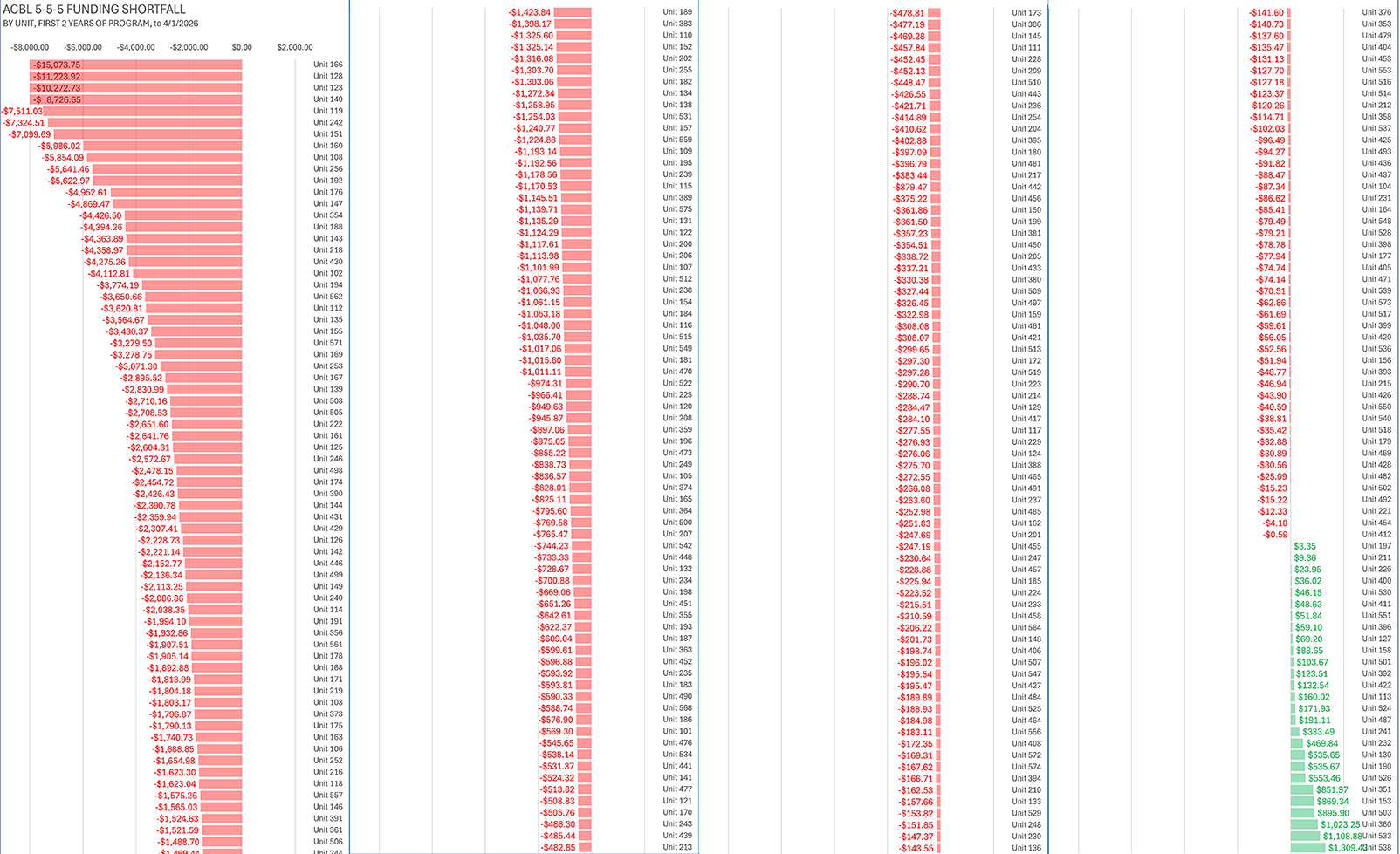 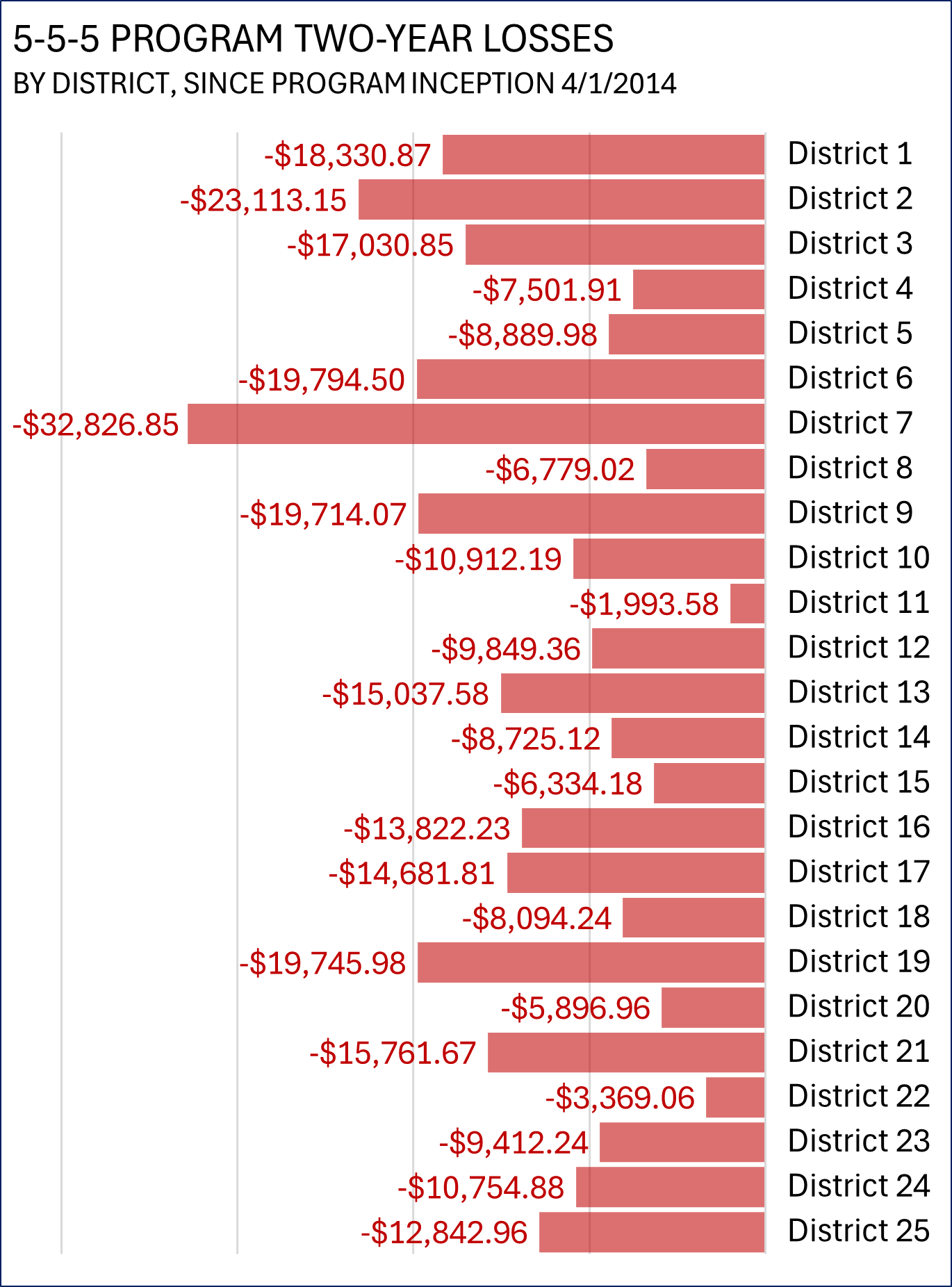 |
 |
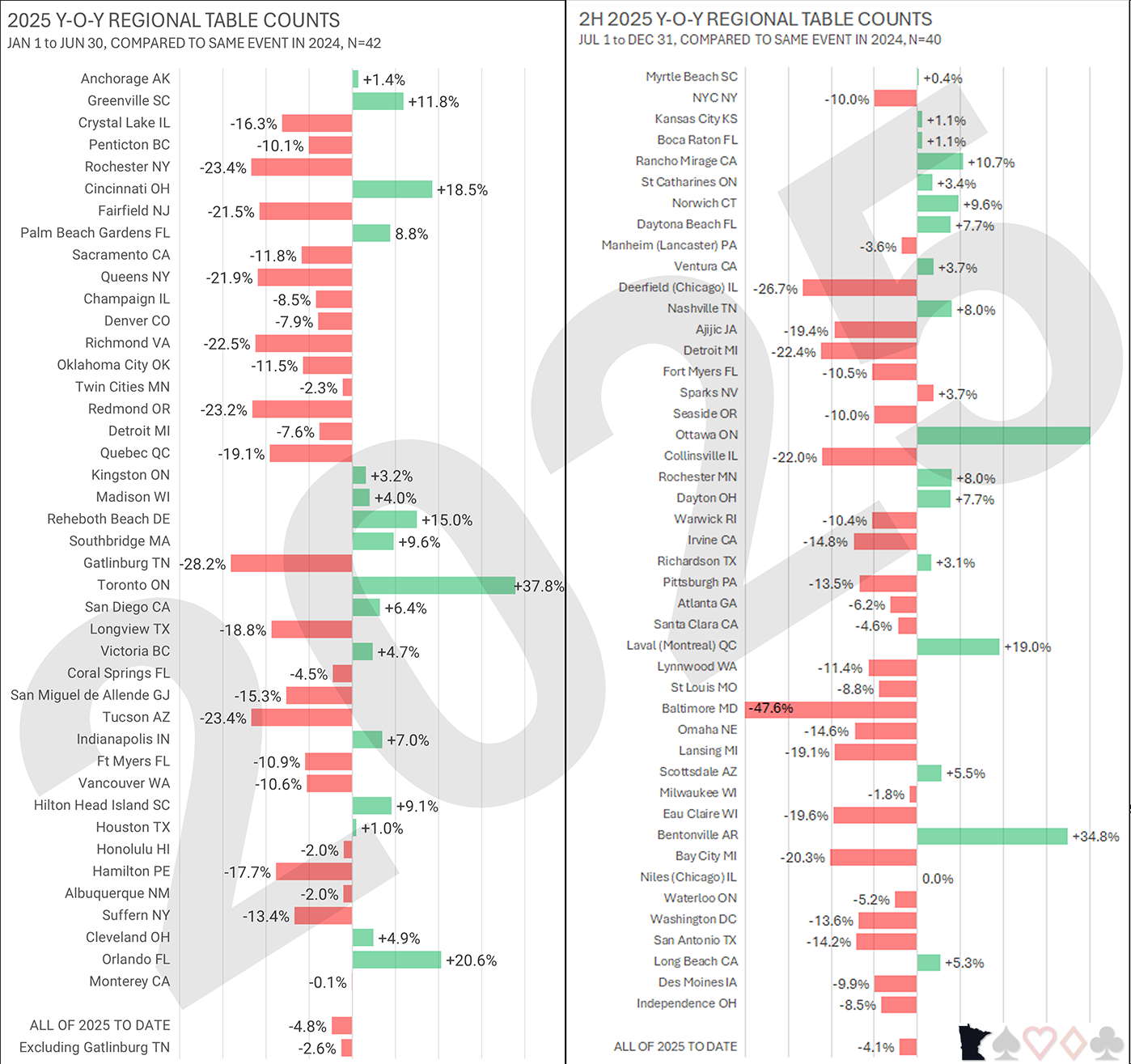
NOTE The "Gatlinburg Effect" which saw the largest dropoff in comparable regionals so far this year (-28.2%), is also the largest table count of any regional and thus a huge part of Y-O-Y numbers; without the 2025 Gatlinburg result, the average change in open regional tables per tournament is actually off -2.6%, not -4.4%. |
  | As of April 2023, the ACBL allowed an online event during your Regional (limited to the district host's players). But just as online tables in the E-clubs have crumbled in the past two years, online tables in these events have fallen sharply just in the past 12 months - and across all tournaments. A look at BBO online tables that are associated with face-to-face Regional tournaments, some tournaments are now struggling to get to the "break even" point financially with an online option (13 online tables or more). That could accelerate this online option's decline even faster. The chart to your left includes the online tables for regional tournaments held in both 2024 and 2025. UPDATE: The ACBL moved to eliminate online play associated with F2F Regionals at the 2025 Summer NABC. They claimed that tournament organizers in general "were not aware of the costs involved" and "more often than not lost money" on the event (which, looking at the chart to your left, you can understand why). And regarding the "Silver Linings Weeks" that the ACBL runs to shovel out silver points during the year; you'll note that their weekly BBO E-Club table totals are quite literally "off the chart" during those weeks. Up to 7 standard deviations above their mean weekly tables. This prompted the ACBL to add a third "Silver Linings Week" to their online schedule in 2024, even if very likely contributing to the decline in face-to-face sectional attendance. Masterpoint inflation is real, and it is spectacular. |